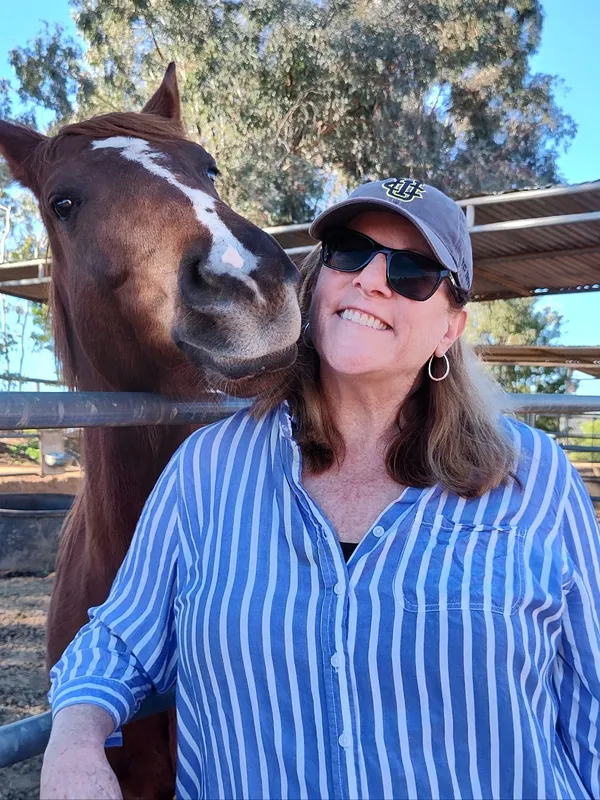
As a Master Facilitator with the Center for Equus Coaching, I have spent years witnessing something quietly profound: horses respond not to who we pretend to be, but to who we actually are. Again and again, they reflect back the patterns, beliefs, and presence we bring into relationship—offering lessons that reach far beyond the arena and into how we lead, live, and relate to others.
One of the earliest lessons I learned is that my expectations directly impact those around me. Herding became one of the most challenging activities for me to master. I often made it unnecessarily difficult by choosing multiple obstacles or consistently selecting the hardest path. Over time, I began to notice that this was not just an arena pattern—it was a life pattern. I was holding myself to extremely high expectations while unintentionally extending that same pressure to my family, coworkers, and peers. Horses helped me see how quickly expectations can create tension, and how powerful it is to return to simplicity, clarity, and compassion.
Horses also taught me to question the stories I tell myself. During an onsite in Colorado, I struggled to move a horse during a herding exercise. Despite every effort, nothing changed. I left that day discouraged and questioning whether I belonged in this work at all. The next morning, the ranch owner explained that the horse had been trained for parades and was intentionally standing still—doing exactly what it had been conditioned to do. In an instant, the story I had built about my inadequacy dissolved. It was a clear reminder of how easily we assign meaning without having the full picture.
Perhaps the most transformative lesson has been energy management. As a collegiate athlete and later in more than 30 years of leading corporate groups, my default approach was to push harder, move faster, and apply pressure to create results. Horses completely disrupted that strategy. They showed me that I do not need to begin with intensity. Instead, I can start grounded, present, and calm—and only increase energy if the situation truly requires it. That shift not only changed my leadership style, it also revealed why burnout had been such a consistent pattern in my life.
Horses have also offered an embodied education in boundaries. Standing next to a horse immediately brings clarity: What is okay? Is it acceptable for the horse to enter my space, nudge me, or stand extremely close? There is no ambiguity—you must know, feel, and communicate your boundary in real time. The second layer is learning how to hold that boundary with consistency and calm presence. What I learned in those moments translates directly into every human relationship I engage in.
They have also shown me the importance of balancing awareness—between my own needs, the needs of my team or family, and the larger environment. Watching horses effortlessly shift between internal regulation, herd awareness, and environmental scanning revealed how dynamic attention truly is. I saw how often I would become stuck in one mode and how leadership requires a fluid, intentional ability to shift presence as needed.
In full disclosure, I was afraid of horses when I first began this work. Several early riding experiences left me convinced they might hurt me. That fear shaped how I initially showed up. Everything changed once I understood horses as prey animals and learned foundational safety principles. My fear softened into respect, then curiosity, and ultimately trust.
Through this work, I have strengthened my leadership skills in ways no traditional training ever accomplished. Horses do not respond to titles or authority—they respond to clarity, consistency, and connection.
What we pay attention to matters. Horses reflect our focus with absolute honesty, showing us where our energy actually lives.
And perhaps most importantly, they have taught me that growth often exists just beyond intimidation. What once felt overwhelming has become grounding, humbling, and deeply transformative.
Every interaction with a horse remains an invitation—to be more present, more honest, and more fully myself.
For more information about Kathy and her work as an Equus Coach, visit Kathyrausin.com.